Geology & Weather
Understanding Madeira Cloud Inversions: How to Read the Arieiro Webcam Before Sunrise
How to decode the Pico do Arieiro summit webcam at 5 AM, spot thermal inversions, identify gray cloud immersion, and know when cloudy Funchal means sunshine above.
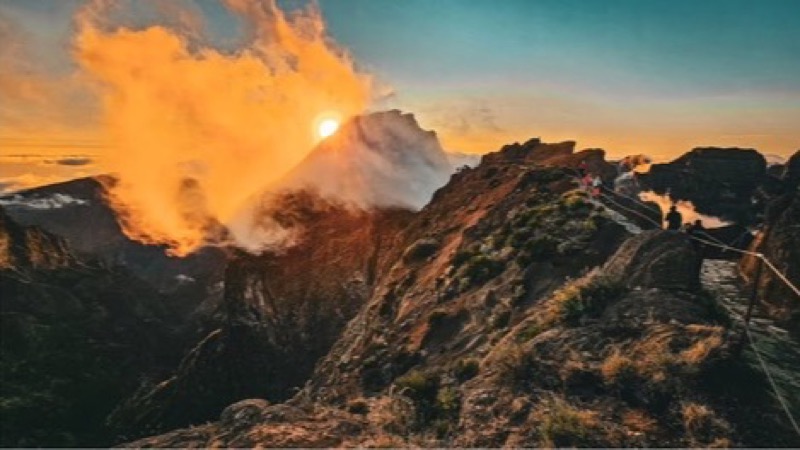
Standing on your hotel balcony in Funchal at five in the morning, looking up at an overcast gray sky, your first instinct is to turn off your alarm and cancel your mountain hike. Most visitors assume that if the coastal city is shrouded in cloud, the mountain summits must be cold, wet, and miserable. On Madeira, that assumption is wrong more than half the time.
The island features a dramatic trade-wind weather pattern. Humid ocean air blowing from the northeast strikes the high central volcanic spine, forcing moisture to condense into a thick blanket of stratocumulus clouds between 800 and 1,400 meters of elevation. When you drive up through that damp layer on the ER181 road, the fog suddenly evaporates around kilometer fourteen. You break out into crisp, dry air under starlight, with the volcanic peaks of Arieiro, Ruivo, and Torres rising like dark islands above a pure white ocean of cloud.
Why the Mountain Camera Looks Gray at Dawn
Before heading out, checking our live summit camera takes less than a minute, but you have to know how to interpret what you see. The Pico do Arieiro camera is an automated JPEG snapshot system updating once every 5 minutes from NetMadeira, rather than a continuous video stream:
- Pre-Dawn Darkness: Before civil twilight, the camera sensor records solid blackness. This is normal night darkness, not a system failure.
- The Gray Fog Trap: If the camera displays a flat, uniform gray rectangle at 6:30 in the morning, the camera is working properly. The gray image confirms that relative humidity at 1,818 meters is near 100 percent, with horizontal visibility reduced to 15 meters and moisture blowing across the rock.
Under total cloud immersion, the mountain ridge offers zero views, and the stone steps become slick. However, if the camera frame shows a sharp horizon line with the white dome of the radar station silhouetted against a dark blue sky, you are looking at clear air above the cloud deck.
The Three Morning Weather Scenarios
Every morning on the central peaks falls into one of three distinct meteorological categories:
- True Thermal Inversion (The Golden Sunrise): The top of the cloud deck sits around 1,200 meters. The summit at 1,818 meters enjoys dry air with 25 to 40 percent relative humidity, calm breezes, and clear views of the rising sun over a rolling white cloud sea. This is ideal hiking weather.
- Summit Immersion (The Washout): Active cold fronts or deep Atlantic troughs push the cloud ceiling above 2,000 meters. The summit sits inside freezing fog, wind gusts exceed 40 km/h, and temperatures hover near freezing. The PR1 trail becomes cold, viewless, and hazardous.
- Blue Sky Everywhere (The Dry Day): Strong high-pressure systems push cloud formation far out to sea. Both the coastal towns and the mountain summits enjoy clear skies, offering panoramic views straight down to the Atlantic Ocean on both the north and south coasts.
The 3-Point Triangulation Routine
Local mountain guides use a simple 3-point webcam check before leaving their accommodation:
- Camera 1 (South Coast Base): Check Funchal Marina to gauge low-level cloud cover over the southern bay.
- Camera 2 (Mid-Elevation Highlands): Check Rabaçal at 1,300 meters on the western plateau. If Rabaçal shows thick fog while coastal towns are clear, the cloud inversion deck is actively forming across mid-altitudes.
- Camera 3 (Summit Ridge): Check Pico do Arieiro at 1,818 meters. If Arieiro shows blue skies or stars above the fog, you have confirmed a classic sea of clouds.
Always pack windproof outerwear, warm gloves, and a fleece jacket regardless of coastal warmth. Summit temperatures before dawn are routinely 10 to 14 degrees Celsius lower than in Funchal, and mountain winds create rapid cooling. Watch the cloud level closely after 9:30 in the morning, as daytime solar heating often forces the cloud deck to rise into the high valleys.
Questions
Short answers. For today, use the cameras. Confirm the fee on SIMplifica.
Related Articles
- How to read the Pico do Arieiro camera
How to interpret the Pico do Areeiro summit camera at 1,818 meters, spot thermal inversions, distinguish fog from sea of clouds, and plan your mountain ascent.
- Madeira's high altitude microclimates: summits above the clouds
Understanding thermal inversions, why mountain summits bask in sunshine while valleys sit under cloud, and extreme altitude humidity drops.
- The North Atlantic orographic engine: how Madeira makes rain
How northeast trade winds collide with Madeira's northern cliffs, generating moisture condensation, rain shadows, and lush laurel cloud forests.