By car
The ER101 sheet, dated 18-11-2016 and still the page online on 7 October 2026, calls the coast road from Ribeira Brava to Machico (Nó Machico Sul) a Via Rápida VR1, run by Concessionária Vialitoral, S.A.. Câmara de Lobos is on that ER101, between Ribeira Brava and Funchal. The sheet prints no kilometre for that piece, and it does not print a driving time from Funchal.
Visit Madeira’s getting-around page, read the same day, says the expressways and the main roads have no tolls. It gives the airport to Funchal as cerca de 20 a 25 minutos. It does not print a time onward to this town.
The ordinary-roads page dated 07-07-2025 names ER 113 as the access to the centre: Câmara de Lobos (ER 108) to Câmara de Lobos (Fonte da Rocha). It prints no length. That is the turn off the expressway for the bay, not a measured drive.
VR2/ER 108 is the other exit. The section sheet dated 23-11-2016, and the expressway list dated 13-01-2025, run it from Câmara de Lobos (ER 101) to Estreito de Câmara de Lobos, 2,50 km, with tunnels of 337 m (Leste) and 270 m (Oeste). That is the climb to Estreito and Jardim da Serra. It is not the way down to the boats.
The old coast road is ER 229. The section sheet dated 22-11-2016 gives Ribeira Brava (ER101) to Cabo Girão as 12,00 km, and Cabo Girão to Câmara de Lobos (ER101) as 7,50 km. The tunnel on the first of those is Variante à Ribeira Brava, 211 m. Edital n.º 76/2025, page dated 10-12-2025, closes a piece of that ER 229 in the parish of Estreito de Câmara de Lobos, on Estrada João Gonçalves Zarco, between ER 231 (Rua Cónego Agostinho Figueira Faria) and the junction with Rua dos Lavradores and Caminho do Pico do Rato. No reopening date. Follow the signs. That closure is not the quay.
A rental car stays on the VR1 until the turn for the centre. The expressway is not a place to stop and look.
By bus, and by taxi
Horários do Funchal’s page for the Salão Ideal viewpoint, read on 7 October 2026, is the one that names a walk into the village. Use line 3 to stop Depois Ribeira Pizo (871B), or line 01 at stop Ponta da Laranjeira (871). The page says the centre is 1 km or 10 minutes walking. The viewpoint itself is Estr. João Gonçalves Zarco 12. The phone on that page is 291 705 555, and the email is geral@horariosdofunchal.pt.
The SIGA renumbering sheet, on the notice dated 20/03/2026, gives line 01 the new number 001, Ponta da Laranjeira, and line 3 the new number 003, Lombada - Pizo (via São Martinho). The notice says the routes and the timetables do not change, and that the new numbers are three digits. It does not print a departure. Open the operator’s timetable before you travel.
The same notice lists the desks: SIGA Rodoeste 291 220 148, Horários do Funchal 291 705 555, CAM 291 201 151, and imt@madeira.gov.pt is imt@madeira.gov.pt, phone 291 145 180, 9:00 - 12:30 / 14:00 - 17:30 on working weekdays.
That Horários do Funchal page also says SIGA Rodoeste buses serve the village. Rodoeste’s schedules page, read the same day, says the company runs between Funchal and Câmara de Lobos, and that there are no buses on the 25th December. It says the clocks are estimates and may change with traffic. It does not print them. On the renumbering sheet the old Rodoeste 7 becomes several numbers, including 200 (Funchal - Ribeira Brava VIA RÁPIDA), 207 (via Estrada Regional) and 267 (via Cabo Girão / Aviceiro). Old 3 becomes 202, Funchal - Estreito de Câmara de Lobos, and 203, Funchal - Castelejo. 258 is Câmara de Lobos - Covão. The sheet names the routes. It does not say which of them stop at the quay. The walk of 1 km or 10 minutes walking is the Horários do Funchal page.
Rodoeste’s fare page prices a single ticket by zone. In the Funchal column, 2 zones are € 2,20 and 8 zones are € 6,00. It does not say how many zones Funchal to Câmara de Lobos is, so no fare for this ride is copied here. A child goes free up to the day before they turn 6, if they do not take a seat. From 6 to 12 the ticket is half the ordinary fare, and not under € 0.85. Visit Madeira also names taxis, and Uber and Bolt. It does not price a ride to the bay. The bus stop is still 1 km or 10 minutes walking from the centre, so a taxi is the way to the quay if you do not want that walk.
Parking
The getting-around page says white lines are free, some of them for residents only, blue lines are paid, and yellow lines mean you cannot stop. Payment is generally Monday to Friday 8h–20h and Saturday 8h–14h. Sunday and holidays are free. Pay at the meter or in the iPark Driver app.
The council’s seafront plan, updated 15 maio 2026, names the current open-air parking area at the Baía, in the Porta da Cidade beside the Winston Churchill viewpoint. The same page proposes a building for 130 vehicles under new terraces, and proposes moving tour coaches to Avenida Nova Cidade. It does not say that building is open. Do not treat 130 as a count of spaces you can use today. Leave the quay clear. The desk is 291 911 080 and 291 944 499, geral@cm-camaradelobos.pt, weekdays 09h00 às 17h00.
What you can do there
NetMadeira’s page for this camera says it sits next to the Teleférico do Rancho and looks over the fishing town. Visit Madeira’s page for that cable car says two cabins of 6 seats each, open every day, at Estrada Stª Clara, Sítio do Rancho, 9300-145 Câmara de Lobos, telefericorancho@hotmail.com. That page prints no fare and no clock.
Cabo Girão is the cliff in the same municipality. Visit Madeira puts it at 580 m, open every day 08:00-20:00, at Estrada do Cabo Girão, 9300-351 Câmara de Lobos. The Portuguese page says pay through SIMplifica, 5,00 € for a visitor over 12, and no charge at 12 or under. Phone (+351) 291 214 120, drpa@madeira.gov.pt. The ER 229 kilometres above are the coast road that passes the miradouro. The skywalk page on this site has the same figures.
Visit Madeira’s town page says the municipality is 51,82 km² with cerca de 35 mil inhabitants, and names the parishes Câmara de Lobos, Curral das Freiras, Estreito de Câmara de Lobos, Jardim da Serra and Quinta Grande. It calls the fishing boats Xavelhas, and says Winston Churchill painted the bay. It names the chapel of Nossa Senhora da Conceição from the século XV, the convent of São Bernardino from 1425, and the church of São Sebastião from the século XVI. None of that is an opening hour. The same page lists Vila do Peixe at Rua Doutor Joao Abel de Freitas Nº 30A, 9300-048, (+351) 291 099 909. The picture does not say if it is open.
What the camera shows
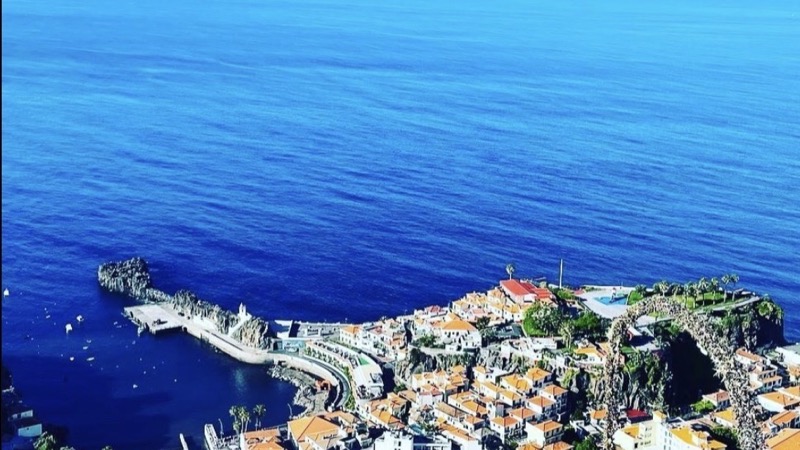
The picture on this page is the Madeira-Web Places Live camera, the Portal Netmadeira stream. The still on the NetMadeira page was 640 by 480 on 7 October 2026, and the YouTube embed that day was 200 by 150, which is 4:3. Use it for the bay, the boats, and cloud on the cliff. It is not a free space in the parking area, and it does not say if a grill is open. Image by Madeira-Web Places Live.
Sources
- Visit Madeira, Câmara de Lobos
- Visit Madeira, Câmara de Lobos in English
- Visit Madeira, getting around
- Regional roads, ER101
- Regional roads, ordinary roads
- Regional roads, expressways
- Regional roads, ER108
- Regional roads, ER229
- Edital n.º 76/2025
- Horários do Funchal, Salão Ideal
- SIGA, new line numbers
- SIGA, renumbering sheet
- Rodoeste, schedules
- Rodoeste, fares
- Câmara Municipal de Câmara de Lobos, seafront plan
- Visit Madeira, Teleférico do Rancho
- Visit Madeira, Cabo Girão
- NetMadeira, this camera
- Portal Netmadeira on YouTube
- Cabo Girão on this site
- The view
- A public lookout for this spot. Use the picture to judge cloud, light, and how busy it looks.
- Useful for
- Check the weather and the crowds before you go.
- It will not show
- You only see what this camera faces. Side paths and indoor queues are out of the picture.
- After dark you mostly see whatever lights are on.
- The camera
- Image by Madeira-Web Places Live
- Getting there
- Follow the signs for the viewpoint. Read the parking notices when you arrive.
What does this picture show, and what does it leave out?
Warm twilight light over the bay with calm sheltered south coast conditions.
It shows what is in front of the camera. It does not show the rest of the island.
Shoes you can walk in, and something for the sun.
When to go
More beach and pool cameras on Madeira Island are on the Madeira beach live cams page. Madeira beach live cams
For a coast-to-Monte read on today’s conditions, see Funchal weather today.
The picture does not say if the grilled-fish places are open.
The picture does not say if the grilled-fish places are open.
The fishing harbour at Câmara de Lobos: the boats in the bay, and the front. The picture does not say if the grilled-fish places are open.
About this webcam
Quick facts
- Location: Câmara de Lobos, Madeira
- Category: Funchal
- Best time to watch: Morning for fishing boat activity and best lighting
- Coordinates: 32.6333, -17.0000
Weather Information
Madeira has a mild climate year-round. Use the webcams for real-time conditions (visibility, sea state, wind).
About the area
This page belongs to the Funchal category in Madeira and groups 18 related webcams. Use the category link to explore nearby views and compare conditions.
Quick Tips for Visitors
- Check local visibility and ocean conditions via the webcam before heading out.
- Madeira weather changes fast: bring a light jacket.
- Respect signage and local guidance.
Highlights
- Traditional fishing village
- Colorful boats and houses
- Historic harbor
- Artistic heritage
Nearby attractions
- Traditional fishing harbor
- Local restaurants
- Cabo Girão Skywalk nearby
Travel tips
- Respect quay and traffic zones.
- Mind traffic/parking at peak hours.
- Check local marine advisories.